Posted on

Evacuation vs. Shelter-in-Place: Does Your Workplace Know the Difference?

When an emergency happens, one question can become very important very quickly:

Do we get out, or do we stay inside?

The answer depends on the emergency.

Sometimes the safest choice is to evacuate.

Other times, leaving the building can put employees in greater danger.

That is why a good Emergency Action Plan should address both evacuation and shelter-in-place when appropriate. OSHA specifically recommends that employers consider the conditions that would require evacuation and the conditions under which sheltering in place may be safer.

Knowing the difference can help employees respond faster and with less confusion.

What Does Evacuation Mean?

Evacuation means leaving a building, work area, or other location because remaining there presents a danger.

The goal is to move employees away from the hazard and toward a safe location.

Depending on the emergency, that might mean:

  • Leaving the entire building
  • Leaving only part of a building
  • Moving to another area of the facility
  • Moving to a designated assembly area
  • Moving away from a specific hazard

OSHA’s Emergency Action Plan standard requires covered employers to establish emergency evacuation procedures, including the type of evacuation and exit route assignments.

When Might a Workplace Evacuate?

Evacuation may be appropriate when remaining inside creates a greater risk.

Examples can include:

  • Fire
  • Explosion
  • Structural damage
  • Certain hazardous-material releases
  • Gas leaks
  • Bomb threats
  • Some workplace violence situations
  • Other emergencies that make the building or work area unsafe

The correct response depends on the specific emergency.

For example, OSHA identifies fires, explosions, chemical releases, natural disasters, civil disturbances, and workplace violence among situations that may require evacuation planning.

What Does Shelter-in-Place Mean?

Shelter-in-place means staying inside a designated safe area instead of evacuating.

The idea is simple:

If the danger is outside the building or moving through the surrounding area, remaining inside may provide more protection than going outside.

OSHA describes shelter-in-place as selecting an interior room or rooms within a facility, often with few or no windows, and taking refuge there.

Depending on the emergency, sheltering may involve:

  • Moving employees to designated interior areas
  • Closing doors and windows
  • Limiting outside air entry when appropriate
  • Taking emergency supplies into the shelter area
  • Accounting for employees
  • Monitoring official instructions
  • Remaining there until authorities or designated personnel provide further instructions

When Might Shelter-in-Place Make Sense?

Shelter-in-place may be appropriate when the hazard is outside the building and leaving would increase exposure.

Examples can include:

  • A hazardous chemical release nearby
  • A transportation accident involving hazardous materials
  • Certain severe weather events
  • A dangerous situation outside the facility
  • Some workplace violence or active-threat situations

OSHA gives the example of a hazardous chemical release near a workplace where remaining indoors may be safer than evacuating through the contaminated area.

The key is to understand the hazard.

Staying inside isn’t automatically safer.

The emergency determines the response.

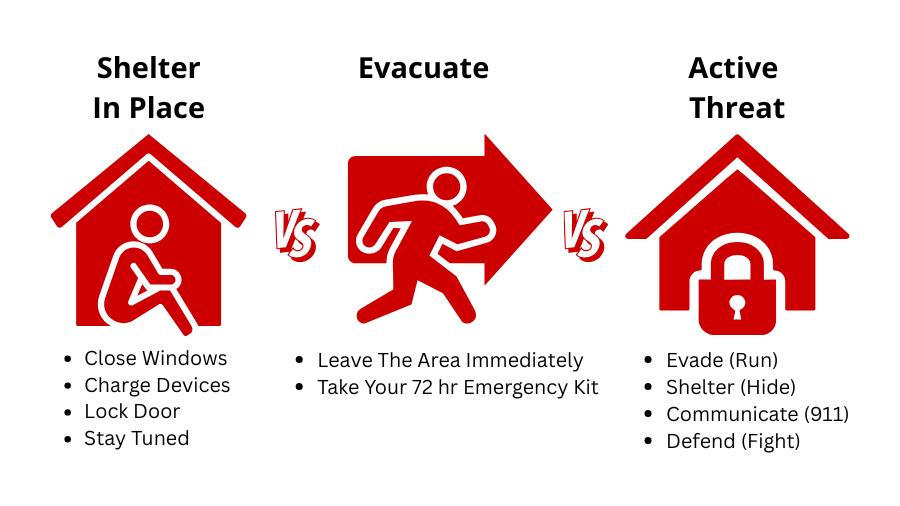
Evacuation vs. Shelter-in-Place

Shelter in place or evacuate

Here’s the simplest way to think about it:

If the danger is…The plan may call for…
Inside the buildingEvacuation may be appropriate
Outside the buildingShelter-in-place may be appropriate
Moving toward or through the facilityFollow the specific emergency plan
A severe weather eventShelter or evacuation may depend on the hazard
A hazardous-material releaseEvacuation or sheltering may depend on the location and type of release
A fire or explosionEvacuation is commonly part of the response
A dangerous intruderEmployees may need to evacuate or shelter depending on circumstances

This isn’t a universal decision table.

The emergency, the workplace, and official instructions all matter.

Your Emergency Action Plan Should Address Both

A strong emergency plan shouldn’t simply say:

“In an emergency, evacuate.”

That’s not enough.

OSHA’s guidance says employers should identify the conditions that require evacuation and the conditions under which shelter-in-place may be better. See here.

Your plan should explain:

  • What situations require evacuation
  • What situations may require shelter-in-place
  • Who can order an evacuation
  • Who can initiate shelter-in-place procedures
  • How employees will be notified
  • Where employees should go
  • How employees will be accounted for
  • What happens to visitors and contractors
  • How employees with special needs will be assisted
  • How employees will receive further instructions

Don’t Use the Same Alarm for Everything

This is an easy detail to overlook.

If your workplace uses alarms or other signals for emergency actions, employees need to understand what those signals mean.

OSHA recommends that different emergency actions use distinguishable notification methods when appropriate. Its shelter-in-place guidance specifically recommends an alert that is distinguishable from the signal used for evacuation.

Think about it this way:

If the alarm goes off, employees shouldn’t have to ask, “What are we supposed to do?”

The signal should trigger a known response.

Where Would Employees Shelter?

“Stay inside” isn’t a complete shelter-in-place plan.

Employees need to know where to go.

A designated shelter area may be:

  • An interior room
  • An area with few or no windows
  • A location away from the hazard
  • An area appropriate for the type of emergency

The best location depends on the emergency.

For example, the ideal shelter location for severe weather may not be the same location used for a chemical release.

That is why emergency planning needs to consider different scenarios.

What Should Be Available in a Shelter Area?

The supplies you need will depend on your workplace and the emergencies you are planning for.

However, consider whether employees may need access to:

  • Emergency communication
  • Flashlights
  • Batteries
  • First aid supplies
  • Drinking water
  • Emergency contact information
  • Employee rosters
  • Basic emergency supplies
  • Appropriate PPE
  • Radios or other communication equipment (NOAA’s Weather Radar and Alerts App – iPhone Android)

For certain shelter-in-place situations, additional supplies may be appropriate.

The goal isn’t to turn a conference room into a survival bunker.

The goal is to make sure employees can safely remain there long enough to receive further instructions.

Account for Everyone

Whether employees evacuate or shelter in place, accountability matters.

Your emergency plan should explain how you will know who is safe.

That can include:

  • Employee rosters
  • Department lists
  • Visitor logs
  • Contractor lists
  • Supervisors
  • Designated accountability personnel

Construction sites may need additional planning because crews and subcontractors can change frequently.

For more information, see our guide to Emergency Preparedness for Construction Sites: What Changes When the Jobsite Changes?

Don’t Forget Visitors and Contractors

Your employees aren’t the only people who may need instructions.

Think about:

  • Visitors
  • Delivery drivers
  • Contractors
  • Temporary workers
  • Customers
  • Vendors

Someone who has never been inside your facility won’t automatically know where to go.

Your emergency procedures should include a way to account for people who aren’t part of your regular workforce.

Employees With Special Needs Need a Plan Too

Emergency planning should consider employees who may need additional assistance.

That could include people with:

  • Mobility limitations
  • Hearing limitations
  • Vision limitations
  • Language barriers
  • Other circumstances that may affect their ability to receive or follow emergency instructions

OSHA specifically recommends considering special-needs employees as part of emergency planning.

The best time to figure this out is before the emergency.

What About Active Threats?

Active-threat situations are a good example of why “always evacuate” isn’t a sufficient emergency plan.

Depending on the circumstances, employees may need to evacuate, shelter, or take other actions based on the immediate threat.

OSHA includes special considerations for evacuation during an active shooter or other dangerous intruder situation in its emergency preparedness guidance.

Employees should receive clear training appropriate to the workplace rather than being expected to make up a response in the moment.

Construction Sites Have an Extra Challenge

Construction sites can make evacuation and shelter planning more complicated.

The safest location can change as the project changes.

Consider:

  • Temporary structures
  • Open floors
  • Excavations
  • Equipment
  • Temporary power
  • Changing access points
  • Changing crews
  • Severe weather exposure
  • Limited enclosed areas

For construction companies, emergency plans should be reviewed as site conditions change.

OSHA’s construction standard, 29 CFR 1926.35, requires employers to establish the types of evacuation to be used in emergency circumstances and to train employees to assist with safe and orderly evacuation.

Practice Both Responses

You can have the best emergency plan in the world.

If nobody has practiced it, employees may still hesitate.

OSHA notes that drills and exercises can help workers understand and remember their roles and responsibilities during emergencies.

Consider practicing different scenarios.

For example:

Scenario 1: Fire in the facility
→ Evacuation

Scenario 2: Hazardous chemical release outside the building
→ Shelter-in-place

Scenario 3: Tornado warning
→ Move to designated shelter

Scenario 4: Emergency affecting one area of the building
→ Partial evacuation or relocation

After each exercise, ask:

What worked?

What didn’t?

What confused people?

Those answers can make your emergency plan better.

A Quick Evacuation vs. Shelter-in-Place Check

Walk through these questions with your team:

Do employees know when they should evacuate?

Do employees know when they may need to shelter in place?

Are evacuation routes clearly identified?

Are shelter locations clearly identified?

Are emergency signals easy to understand?

Can employees receive emergency instructions?

Do you have a way to account for employees?

Are visitors and contractors included?

Have special-needs considerations been addressed?

Are shelter supplies available where needed?

Have employees practiced the procedures?

Has the plan been reviewed since the workplace or jobsite changed?

If several answers are “I’m not sure,” that’s a good indication that your emergency plan deserves another look.

The Goal Is Knowing What to Do Before You Need It

Evacuation and shelter-in-place are not competing safety philosophies.

They are different tools for different emergencies.

The right response depends on the hazard, the workplace, and the information available at the time.

The important part is planning ahead.

Your employees should not have to figure out the plan while the emergency is happening.

They should already know:

Where do I go?

How do I get there?

What am I supposed to do when I get there?

Who tells me when it is safe?

That’s what preparedness looks like.

Take the Checklist to the Workplace

Want to put your emergency preparedness plan to the test?

Our Workplace Emergency Preparedness Checklist gives you a practical way to review evacuation, communication, accountability, emergency supplies, and other important areas.

Download the Workplace Emergency Preparedness Checklist and walk through it with your team.

Keep Building Your Emergency Preparedness Plan

This article is part of our National Preparedness Month workplace safety series.

For the big-picture guide, visit our National Preparedness Month: A Complete Guide to Workplace Emergency Preparedness.

You can also read:

10 Workplace Emergency Preparedness Mistakes That Could Leave Your Team Unprepared

What Does OSHA Require for an Emergency Action Plan?

Spill Happens: What Every Workplace Should Know About Spill Response

Emergency Preparedness for Construction Sites: What Changes When the Jobsite Changes?

Important Note

This article is provided for general educational purposes and is not legal or safety consulting advice. Emergency procedures should be developed for the specific hazards and conditions of your workplace. Always follow instructions from emergency responders and local authorities during an actual emergency.

Posted on

Emergency Preparedness for Construction Sites:

What Changes When the Jobsite Changes

Construction sites have one thing that many other workplaces don’t:

They don’t stay the same.

The entrance may move.

A new floor gets added.

Temporary power changes.

Equipment comes and goes.

Crews change.

New subcontractors arrive.

And the hazards can change right along with them.

That creates a unique challenge for emergency preparedness.

A plan that made sense two months ago may not make sense today.

For construction companies, emergency preparedness needs to be more than a document created at the beginning of a project. It needs to keep up with the jobsite.

Why Construction Sites Need a Different Approach

A traditional workplace may have the same exits, assembly area, equipment, and employees every day.

A construction site can change from week to week.

That means emergency planning needs to account for changing conditions.

Some of the challenges can include:

  • Changing access points
  • Temporary stairways and ladders
  • Openings and unfinished floors
  • Temporary electrical systems
  • Heavy equipment
  • Excavation and trenching
  • Scaffolding
  • Cranes and lifts
  • Welding and hot work
  • Flammable materials
  • Chemicals and fuels
  • Changing weather conditions
  • Multiple contractors and subcontractors
  • Employees who may not regularly work at the site

Because the jobsite changes, the emergency plan needs to change with it.

What Does OSHA Say About Construction Emergency Plans?

OSHA’s construction standard, 29 CFR 1926.35, addresses employee emergency action plans.

The standard requires employers to have an emergency action plan for workplaces covered by the requirement. The plan addresses emergency escape procedures, emergency reporting, procedures for employees who remain behind for critical operations, accounting for employees, rescue and medical duties, and designated employees who assist with evacuation.

Construction employers must also designate and train enough people to assist with a safe and orderly emergency evacuation.

OSHA also requires the plan to be reviewed with employees when appropriate, including when employees are initially assigned to the job and when their responsibilities under the plan change.

The important takeaway is simple:

Your construction site needs an emergency plan that employees can actually use.

Start With the Hazards on This Jobsite

Every construction project is different.

So don’t start with a generic emergency plan and assume it covers everything.

Start with the hazards.

Ask:

What could realistically go wrong here?

Depending on the project, that might include:

  • Fire
  • Severe weather
  • Electrical incidents
  • Falls
  • Equipment accidents
  • Trench or excavation emergencies
  • Structural collapse
  • Chemical spills
  • Fuel releases
  • Confined-space emergencies
  • Medical emergencies
  • Utility strikes
  • Heat-related emergencies
  • Workplace violence
  • Flooding
  • Power outages

The list should reflect the actual work being performed.

A high-rise project and a road construction project may have very different emergency risks.

Know How Employees Will Report an Emergency

When something goes wrong, employees shouldn’t have to figure out who to call.

Your plan should clearly explain how emergencies are reported.

Depending on the project, that might include:

  • Calling 911
  • Using a site radio
  • Contacting the superintendent
  • Contacting the safety manager
  • Activating an alarm
  • Using a designated emergency phone

Make sure employees know the procedure.

This is especially important for new workers and subcontractors who may not be familiar with the site.

Keep Emergency Contact Information Current

Construction projects can have a long list of important contacts.

That may include:

  • 911
  • Site superintendent
  • Project manager
  • Safety manager
  • General contractor
  • Property owner
  • Utility companies
  • Emergency medical services
  • Fire department
  • Local emergency management
  • Environmental or hazardous-material response contacts

Don’t let the emergency contact list become another outdated document.

Review it when project contacts change.

Know Where the Emergency Access Points Are

Emergency responders need to be able to find you.

That sounds obvious.

On a construction site, it isn’t always easy.

Temporary roads, gates, equipment, fencing, materials, and changing site conditions can make access difficult.

Make sure employees know:

  • The current site address
  • The best emergency entrance
  • Gate locations
  • Access roads
  • Restricted areas
  • Designated emergency vehicle routes
  • The location of the nearest hospital or medical facility

If the site is large, consider how responders will find the exact area where an incident occurs.

“Come to the construction site” isn’t exactly a great set of directions.

Establish an Assembly Area

Employees need to know where to go after an evacuation.

That means identifying an assembly area that is:

  • Safe from the emergency
  • Accessible
  • Easy to identify
  • Away from emergency vehicle access
  • Large enough for the expected number of people

However, remember that a construction site’s assembly area may need to change.

A location that is safe today may be directly beside tomorrow’s excavation or equipment operation.

Check it as the jobsite changes.

Account for Employees and Subcontractors

Getting everyone out is only half the job.

You also need to know who is missing.

Construction sites may have:

  • General contractor employees
  • Subcontractors
  • Temporary workers
  • Delivery drivers
  • Inspectors
  • Visitors
  • Vendors

That can make accountability challenging.

Your emergency plan should explain how workers will be accounted for and who is responsible for doing it.

Don’t rely entirely on someone yelling, “Is everybody here?”

Use whatever system makes sense for your project.

That could include:

  • Daily sign-in systems
  • Badging
  • Crew rosters
  • Foreman accountability
  • Visitor logs
  • Digital workforce tracking systems

The important thing is that someone owns the process.

Keep Evacuation Routes Usable

A construction site can create new obstacles every day.

Materials get delivered.

Equipment gets parked.

Temporary walls go up.

Stairways change.

Access routes move.

Emergency exits and evacuation paths need to be kept clear and communicated to workers.

Employees should know how to get out from the areas where they are actually working.

That may mean different routes for different phases of the project.

Don’t Forget About Temporary Conditions

Construction sites frequently use temporary systems.

These can include:

  • Temporary electrical systems
  • Temporary stairs
  • Temporary lighting
  • Temporary barriers
  • Temporary access roads
  • Temporary fire protection
  • Temporary structures

Temporary does not mean unimportant.

If a temporary condition changes the way employees evacuate or respond to an emergency, it belongs in the safety conversation.

Severe Weather Can Change Everything

Weather is one of the biggest reasons construction emergency planning needs to stay flexible.

Construction workers may be exposed to:

  • Lightning
  • Tornadoes
  • High winds
  • Heavy rain
  • Flooding
  • Extreme heat
  • Winter weather
  • Hail

A severe-weather plan should explain how employees will receive warnings and where they should go.

For example, an open construction site may not provide adequate shelter during a tornado.

A plan should identify appropriate shelter locations before severe weather arrives.

Don’t wait until the sky turns green to decide where everyone is going.

Excavation and Trench Emergencies

Excavation work creates hazards that require specialized planning.

A trench collapse can happen quickly.

Employees should understand that an unplanned rescue attempt can create additional victims.

Construction emergency planning should identify how excavation emergencies will be reported and how qualified emergency responders will be contacted.

OSHA’s excavation standards contain specific requirements for protective systems, access and egress, inspections, and other excavation hazards. Emergency preparedness should work alongside those requirements rather than replace them.

Never treat a trench rescue like a normal cleanup job.

Falls and Rescue Planning

Falls are another important consideration.

Construction sites may involve:

  • Roof work
  • Leading edges
  • Scaffolds
  • Lifts
  • Ladders
  • Structural steel
  • Openings

A fall-arrest system may save a worker’s life, but it can also create a need for prompt rescue planning.

A worker suspended in a harness after a fall may need assistance.

That means employers should consider rescue procedures when developing their fall protection program rather than simply asking, “Do we have harnesses?”

Fall protection and rescue planning go together.

Fire and Hot Work

Welding, cutting, grinding, roofing, temporary heating, and other hot-work activities can introduce fire hazards.

Construction emergency planning should consider:

  • Fire extinguishers
  • Alarm methods
  • Emergency exits
  • Flammable materials
  • Fuel storage
  • Hot-work procedures
  • Fire watch responsibilities
  • Emergency access for responders

Employees should know what they are expected to do if a fire starts.

They should also know when the appropriate response is to evacuate rather than attempt to extinguish the fire.

Spill Response on Construction Sites

Construction sites can contain fuel, oils, paints, solvents, adhesives, cleaning products, and other materials.

That means spill preparedness belongs in the emergency plan.

Employees should know:

  • What materials are present
  • Where SDS information is available
  • Where spill kits are located
  • What PPE is required
  • How to report a spill
  • When an incidental spill can be safely handled
  • When employees should leave the area and call for help

Not every spill should be handled by the person who happens to be standing closest to it.

For more information, see our guide:

Spill Happens: What Every Workplace Should Know About Spill Response

Medical Emergencies

Construction sites should also have a plan for medical emergencies.

Depending on the project, consider:

  • First aid supplies
  • Trained first-aid personnel
  • AED availability
  • Emergency communication
  • Site access for EMS
  • Address or GPS information
  • Nearest medical facility
  • Procedures for serious injuries

Make sure employees know how to get help quickly.

Minutes matter during a serious injury.

New Workers Need Emergency Information

Construction sites regularly bring new workers onto the project.

That makes orientation important.

A new employee or subcontractor should understand the site’s emergency procedures before starting work.

At a minimum, workers should know:

  • How to report an emergency
  • Emergency exits and routes
  • Assembly locations
  • Alarm signals
  • Emergency contacts
  • First aid locations
  • Severe-weather procedures
  • Site-specific hazards

A five-minute conversation can be much more useful than handing someone a 40-page document and saying, “Read this.”

Subcontractors Need to Be Part of the Plan

A construction site’s emergency plan shouldn’t stop with the general contractor’s employees.

Subcontractors need to understand the site’s emergency procedures too.

Different companies may have different:

  • Radios
  • Communication systems
  • Emergency procedures
  • Training
  • PPE
  • Supervisors

The jobsite still needs one coordinated emergency response.

Make sure subcontractors know how the site’s emergency system works and who is responsible for coordinating the response.

Review the Plan When the Jobsite Changes

This may be the biggest difference between construction emergency preparedness and emergency planning in a permanent facility.

The jobsite changes.

So review the plan when:

  • A new phase of construction begins
  • Site access changes
  • Crews change
  • New hazards are introduced
  • Temporary structures are added
  • Work moves to a different area
  • Evacuation routes change
  • The assembly area changes
  • Emergency contacts change
  • New subcontractors arrive
  • A drill identifies a problem
  • An incident occurs

Don’t wait for the annual safety meeting to discover that the emergency exit is now behind a stack of drywall.

A Quick Construction Emergency Preparedness Check

Take the Checklist to the Jobsite

Emergency preparedness is easier to evaluate when you have something practical to work from.

Our Workplace Emergency Preparedness Checklist gives you a simple way to review your emergency procedures, supplies, communication, evacuation, accountability, and other key areas.

Download the checklist and walk the jobsite with it. You may find a few things that need attention before an emergency puts your plan to the test.

Walk the site and ask:

Does everyone know how to report an emergency?

Is the current site address clearly available?

Can emergency responders easily access the site?

Are evacuation routes current?

Is the assembly area still safe?

Can employees be accounted for?

Are subcontractors included?

Are emergency contacts current?

Are first aid supplies available?

Are spill supplies appropriate for the materials on site?

Are employees prepared for severe weather?

Have fall-rescue needs been considered?

Have excavation and trench emergencies been addressed where applicable?

Has the emergency plan been reviewed since the jobsite changed?

If you answered “I’m not sure” to several of these questions, your emergency plan may need an update.

Emergency Preparedness Is a Moving Target

Construction safety already requires you to think about what can go wrong.

Emergency preparedness takes that thinking one step further.

It asks:

What happens if something goes wrong, and how are we going to respond?

The answer can change as the project changes.

That is why emergency preparedness shouldn’t be treated as a one-time paperwork requirement.

Walk the site.

Talk to the crews.

Review the hazards.

Check the equipment.

Update the plan.

Then do it again when the job changes.

Because on a construction site, the only thing you can count on staying the same is that something will change.

Keep Building Your Emergency Preparedness Plan

This article is part of our National Preparedness Month workplace safety series.

For a broader look at emergency preparedness, visit our National Preparedness Month: A Complete Guide to Workplace Emergency Preparedness.

You can also read:

National Preparedness Month

10 Workplace Emergency Preparedness Mistakes That Could Leave Your Team Unprepared

What Does OSHA Require for an Emergency Action Plan?

Spill Happens: What Every Workplace Should Know About Spill Response

Important Note

This article is provided for general educational purposes and is not legal or safety consulting advice. Construction projects have different hazards and requirements. Employers should review the OSHA standards applicable to their work, project-specific requirements, and emergency procedures with qualified safety professionals.

Sources

Posted on

Spill Happens: What Every Workplace Should Know About Spill Response

Let’s face it.

Spills happen.

A container gets knocked over. A hydraulic line leaks. A drum develops a problem. Someone drops a bottle of cleaning chemical.

The question isn’t whether your workplace will ever have a spill.

The better question is:

Will your employees know what to do when one happens?

A good spill response plan can help employees recognize hazards, protect themselves, contain an appropriate spill, and know when it is time to step away and call for help.

Workplace spill response
Drum develops a problem

What Is a Workplace Spill Response Plan?

A spill response plan explains what employees should do when a material is accidentally released.

The plan should be based on the materials used or stored at your workplace and the hazards they present.

Depending on your operation, that could include:

  • Oil and lubricants
  • Fuel
  • Cleaning chemicals
  • Paints and coatings
  • Solvents
  • Battery chemicals
  • Industrial chemicals
  • Bodily fluids
  • Other hazardous substances

Your plan should also identify who is responsible for responding, what equipment is available, and when employees should evacuate or call for outside assistance.

Not Every Spill Is an Emergency

This is one of the most important things to understand.

OSHA’s Hazardous Waste Operations and Emergency Response standard, commonly called HAZWOPER, makes an important distinction between an incidental release and an emergency response.

An incidental release is one that employees in the immediate area can safely absorb, neutralize, or otherwise control without creating a significant safety or health hazard.

An uncontrolled release of a hazardous substance, or a release that creates a significant potential for fire, explosion, or exposure, can require a much different response.

In other words:

A small spill that you can safely control is not the same thing as an uncontrolled hazardous-material release.

That distinction matters.

Employees should never be encouraged to “just clean it up” simply because a spill looks small.

Step 1: Stop and Identify the Hazard

Before anyone reaches for a spill kit, stop.

Ask:

What spilled?

If the material is unknown, employees should not guess.

Check the container label and the Safety Data Sheet (SDS), when available. The SDS can provide important information about hazards, handling, required PPE, first aid, storage, and accidental-release measures.

Employees should also consider:

  • Is the material flammable?
  • Can it produce harmful vapors?
  • Can it burn the skin?
  • Can it damage the eyes?
  • Is it reactive?
  • Is there a risk of exposure?
  • Is the spill spreading?
  • Could it reach a drain or waterway?
  • Is there a fire or explosion hazard?

If employees cannot safely identify or assess the material, back away and get help.

Step 2: Protect People First

The first priority is not saving the floor.

It’s protecting people.

Depending on the situation, the appropriate response may include:

  • Alerting nearby employees
  • Isolating the area
  • Preventing unnecessary access
  • Moving employees away from the release
  • Using an emergency alarm
  • Evacuating the area
  • Calling emergency responders

Do not let the desire to save a product, floor, machine, or cleanup cost put someone in danger.

People first. Property second.

Step 3: Know Your Spill Kit

A spill kit is only useful if employees know where it is and know how to use it.

A basic spill kit may include items such as:

  • Absorbent pads
  • Absorbent socks or booms
  • Granular absorbent
  • Disposal bags
  • Gloves
  • Eye protection
  • Protective clothing
  • Warning or caution tape
  • Other equipment appropriate for the material being handled

The right kit depends on the hazard.

For example, an oil-only spill kit is designed for petroleum-based liquids. A universal kit may be suitable for many non-aggressive liquids. Chemical spills may require specialized absorbents and PPE.

One spill kit does not automatically fit every spill.

Step 4: Wear the Right PPE

PPE should be selected based on the hazard.

That may include:

  • Chemical-resistant gloves
  • Safety glasses
  • Goggles
  • Face shields
  • Protective clothing
  • Chemical-resistant aprons
  • Respiratory protection when required
  • Safety footwear

The important word is appropriate.

A pair of disposable gloves may be perfectly reasonable for one cleanup and completely inadequate for another.

OSHA’s HAZWOPER requirements emphasize hazard evaluation and the use of appropriate engineering controls, work practices, and PPE for covered hazardous-material operations.

Employees should know what PPE is required before they begin cleanup.

Step 5: Stop the Spill From Spreading When It Is Safe

If the situation is safe to control, employees may need to prevent the material from spreading.

That might mean:

  • Uprighting a container
  • Closing a valve
  • Placing absorbent socks around the spill
  • Protecting nearby drains
  • Using appropriate absorbent material
  • Moving unaffected materials away from the area

But there is an important limitation:

Do not attempt to stop a release if doing so would expose an employee to an unsafe condition.

Containment is not worth an injury.

Step 6: Keep Spills Away From Drains

A spill that reaches a floor drain can quickly become a much bigger problem.

Depending on the material, a release can move beyond the immediate work area and potentially reach wastewater systems, soil, or waterways.

That’s why drain covers and absorbent socks can be valuable components of a spill response program.

Employees should know where these supplies are located before an emergency happens.

Step 7: Clean Up and Dispose of Materials Properly

Once the spill has been safely contained, cleanup materials still need to be handled correctly.

Used absorbents, contaminated PPE, containers, and other cleanup materials may need special handling or disposal depending on what they contain.

Don’t assume that everything used to clean up a chemical spill can simply go into the regular trash.

The material, the amount released, and applicable environmental and waste requirements can all affect disposal decisions.

When in doubt, consult the SDS, your workplace procedures, environmental requirements, and qualified professionals.

When Should Employees NOT Clean Up a Spill?

This may be the most important section of this article.

Employees should not attempt to clean up a release simply because they have access to a spill kit.

Stop and get help when:

  • The material is unknown.
  • The spill is spreading rapidly.
  • There is a fire or explosion hazard.
  • Dangerous vapors are present.
  • Employees may be exposed to a hazardous substance.
  • The spill is beyond the employee’s training.
  • The required PPE is not available.
  • The release cannot be safely contained.
  • The incident requires specialized equipment or trained responders.
  • The workplace emergency plan calls for evacuation.

OSHA’s HAZWOPER standard specifically distinguishes emergency response to uncontrolled releases from incidental releases that can be safely controlled by employees in the immediate area.

Knowing when not to respond is part of good emergency preparedness.

Training Matters

A spill response plan only works if employees understand it.

Employees should know:

  • What materials they may encounter
  • Where SDSs are located
  • Where spill kits are stored
  • What PPE is required
  • How to report a spill
  • How to isolate an area
  • When they can handle an incidental spill
  • When they should evacuate
  • Who to contact for help

For workplaces covered by HAZWOPER emergency-response requirements, OSHA has specific training requirements based on the employee’s role in the response.

Don’t Forget to Check the Spill Kit

This one sounds obvious.

It isn’t.

Spill kits have a way of becoming the workplace equivalent of the junk drawer.

Someone uses half the absorbent.

The gloves disappear.

The disposal bags get borrowed.

Nobody replaces anything.

Then six months later, there is a spill.

And suddenly everyone discovers that the “spill kit” isn’t really a spill kit anymore.

Check your supplies regularly.

Make sure employees can find them quickly.

Replace used or expired supplies.

Keep the appropriate PPE nearby.

And make sure the equipment matches the hazards present in your workplace.

A Quick Spill Response Checklist

Use this as a simple starting point for your workplace:

Do employees know how to report a spill?

Are hazardous materials clearly identified?

Are current SDSs accessible?

Does your workplace have the right type of spill kit?

Do employees know where spill kits are located?

Is appropriate PPE available?

Do employees know when they can handle an incidental spill?

Do employees know when to evacuate?

Are emergency contacts easy to find?

Are used spill supplies replaced promptly?

Are employees trained on your spill response procedures?

If you answered “I’m not sure” to a few of these, that’s a good reason to review your spill response plan.

Spill Preparedness Is Part of Emergency Preparedness

A spill doesn’t have to become a major emergency.

Good preparation can help employees recognize the hazard, protect themselves, contain an appropriate release, and get the right help when the situation goes beyond their training.

That starts before the spill happens.

Know your hazards.

Know your procedures.

Know your PPE.

Know your spill supplies.

And most importantly, know when to walk away.

Keep Building Your Emergency Preparedness Plan

Spill response is only one piece of workplace emergency preparedness.

For a broader look at preparing your workplace, visit our National Preparedness Month: A Complete Guide to Workplace Emergency Preparedness.

You can also read 10 Workplace Emergency Preparedness Mistakes That Could Leave Your Team Unprepared for a look at common gaps that can leave a team scrambling when an emergency occurs.

And if you’re working on your Emergency Action Plan, check out What Does OSHA Require for an Emergency Action Plan?

Important Note

This article is provided for general educational purposes and is not legal, environmental, or safety consulting advice. Spill response requirements can vary based on the material involved, the workplace, the quantity released, and applicable federal, state, and local requirements. Always follow your workplace emergency procedures, Safety Data Sheets, applicable OSHA requirements, and instructions from qualified professionals and emergency responders.

Sources

Posted on

What Does OSHA Require for an Emergency Action Plan?

If an emergency happened at your workplace or jobsite today, would your employees know what to do?

That is the basic purpose of an Emergency Action Plan (EAP).

An EAP establishes procedures for employees and employers to follow during workplace emergencies. OSHA says a well-developed plan should be based on the hazards at the worksite, its layout, structural features, emergency systems, and the types of emergencies workers could encounter.

But here’s where things can get confusing:

Does OSHA require every employer to have a written Emergency Action Plan?

Not necessarily under the same requirement.

OSHA’s 29 CFR 1910.38 says an employer must have an EAP when an OSHA standard in that part requires one. OSHA’s construction standard, 29 CFR 1926.35, similarly applies to emergency action plans required by a particular OSHA standard. Other OSHA standards can trigger EAP requirements as well.

So let’s break down what employers need to know.


What Is an Emergency Action Plan?

An Emergency Action Plan is a workplace plan that describes the actions employers and employees should take to protect themselves during an emergency.

Depending on the workplace, emergencies may include:

  • Fire
  • Severe weather
  • Chemical releases
  • Explosions
  • Flooding
  • Utility failures
  • Equipment incidents
  • Workplace injuries
  • Structural emergencies
  • Other events that could threaten employees

OSHA recommends starting with a hazard assessment to identify physical and chemical hazards that could cause an emergency. The plan should then describe how workers will respond to the emergencies relevant to that particular workplace.

A generic plan downloaded from the internet isn’t necessarily a good plan for your workplace.

Your plan should reflect your actual operation.


Does OSHA Require Every Business to Have an EAP?

The short answer: No—not under 29 CFR 1910.38 alone.

This is one of the most common points of confusion.

Under 29 CFR 1910.38(a), an employer must have an Emergency Action Plan whenever an OSHA standard in Part 1910 requires one.

OSHA identifies several standards that can require compliance with 1910.38, including standards addressing areas such as:

  • Process Safety Management
  • Hazardous materials and emergency response
  • Fire protection
  • Grain handling
  • Certain chemical exposures
  • Other specific workplace hazards

OSHA’s EAP guidance also provides an expert system employers can use to help determine whether their circumstances trigger the requirement.

For construction, 29 CFR 1926.35 applies to emergency action plans required by a particular OSHA standard and establishes minimum elements for those plans.

The important takeaway:

Don’t interpret “OSHA doesn’t require every employer to have an EAP under 1910.38” as “we don’t need an emergency plan.”

OSHA recommends emergency planning as a fundamental part of preparing for workplace emergencies, regardless of whether a particular standard triggers the written EAP requirement.


What Must an OSHA Emergency Action Plan Include?

When an EAP is required under 29 CFR 1910.38, OSHA specifies six minimum elements.

1. Procedures for Reporting a Fire or Other Emergency

Employees need to know how to report an emergency.

That could include:

  • Calling 911
  • Calling an internal emergency number
  • Activating a fire alarm
  • Contacting a supervisor
  • Using a radio or other designated communication system

The important thing is that employees understand the procedure before an emergency occurs.

Ask your team:

“If you discovered a fire or serious emergency right now, exactly how would you report it?”

If employees give five different answers, your plan may need some work.


2. Emergency Evacuation Procedures and Exit Routes

Your EAP must address emergency evacuation procedures, including the type of evacuation and exit-route assignments.

Employees should understand:

  • When evacuation is required
  • Who can order an evacuation
  • Which routes to use
  • Where to assemble
  • What alternate routes are available
  • What they should do if their normal route is blocked

OSHA’s guidance notes that evacuation procedures should be designed around the specific emergencies that could occur at the workplace.

Don’t forget changing jobsites.

A construction site may have different access points, routes, equipment, excavations, structures, and work areas from one month to the next.

A route that worked when the project began may not be the best route today.


3. Procedures for Employees Who Remain to Perform Critical Operations

Some workplaces have operations that cannot simply be abandoned immediately.

The EAP must address procedures for employees who remain to operate critical plant operations before evacuating.

Examples might include procedures for safely shutting down equipment or processes before evacuation.

This section should be specific to your operation.

It should also be clear who is trained and authorized to perform those tasks.

You don’t want an emergency to become more dangerous because several employees independently decide to “shut things down.”


4. Procedures for Accounting for Employees After Evacuation

Getting everyone outside is only half the job.

You also need to know:

Is everyone actually out?

OSHA requires procedures for accounting for employees after evacuation under 29 CFR 1910.38(c)(4).

Your accountability procedure may need to consider:

  • Different shifts
  • Multiple work areas
  • Contractors
  • Temporary workers
  • Visitors
  • Employees working away from the main facility
  • Large or changing construction sites

A simple headcount may work for a small office.

A large construction project may require something more sophisticated.

The method needs to fit the workplace.


5. Rescue and Medical Duties

If employees are assigned rescue or medical responsibilities as part of the emergency plan, those duties need to be addressed in the EAP.

This is also an area where employers need to be careful.

Don’t assign people emergency-response responsibilities simply because they happen to be nearby.

Employees performing designated rescue or medical duties need appropriate training and preparation for those responsibilities.

For hazardous-substance emergencies, additional OSHA requirements may apply depending on the employer’s role in the response.


6. Names or Job Titles of People Employees Can Contact

The plan must identify the name or job title of employees who can be contacted for additional information about the plan or an explanation of their duties.

This sounds simple.

But ask yourself:

Are those names and job titles still correct?

People change positions.

Employees leave.

Phone numbers change.

Responsibilities change.

An emergency plan should not depend on a person who left the company six months ago.

Keep your contact information current.


What About Employee Alarm Systems?

Under 29 CFR 1910.38(d), employers must have and maintain an employee alarm system when the standard applies. The alarm system must provide warning for necessary emergency action and comply with OSHA’s alarm requirements under 1910.165.

Employees need to understand what the alarm means and what action they are expected to take.

An alarm that nobody recognizes isn’t much of an emergency communication system.

Ask:

Does everyone know what our emergency alarm sounds like—and what they’re supposed to do when they hear it?


Does OSHA Require Emergency Action Plan Training?

Yes, when the EAP requirements apply, OSHA requires employers to designate and train a sufficient number of employees to assist in a safe and orderly evacuation.

The plan also needs to be reviewed with employees at specific times, including:

  • When the plan is developed
  • When an employee is initially assigned to a job
  • When the employee’s responsibilities under the plan change
  • When the plan itself changes

The construction requirements under 29 CFR 1926.35 similarly address reviewing the plan with employees and training designated employees who assist with evacuation.

Training shouldn’t mean simply handing someone a copy.

Employees should understand the parts of the plan that apply to them.


How Often Should an Emergency Action Plan Be Reviewed?

There isn’t one simple OSHA answer that says every workplace must review its entire EAP on a particular annual schedule under 1910.38.

However, OSHA’s requirements specifically call for review when the plan is developed, when employee responsibilities change, and when the plan changes.

And OSHA’s broader emergency-preparedness guidance recommends evaluating the plan and keeping it current as workplace conditions change.

Good times to review your plan include when:

  • You move or remodel a facility
  • Equipment changes
  • New chemicals or hazardous materials are introduced
  • Processes change
  • Emergency equipment changes
  • Employee responsibilities change
  • New hazards are identified
  • A construction site changes significantly
  • A drill identifies a problem
  • An actual emergency exposes a weakness

Don’t wait for the next emergency to discover that your plan is outdated.


What About Construction Sites?

Construction deserves special attention.

Under 29 CFR 1926.35, an emergency action plan required by an applicable OSHA standard must be in writing, subject to the exception provided in the standard, and must cover the designated actions employers and employees need to take to protect workers during fire and other emergencies.

The minimum elements include:

  • Emergency escape procedures and route assignments
  • Procedures for employees who remain to operate critical operations
  • Procedures for accounting for employees
  • Rescue and medical duties
  • Means of reporting fires and emergencies
  • Names or job titles of people who can provide additional information

OSHA also emphasizes that emergency planning needs to account for the specific worksite.

That matters on construction projects because the workplace isn’t static.

The jobsite you planned for in March may not be the jobsite you’re standing on in September.


What About Spill or Hazardous-Material Emergencies?

This is where emergency action planning can become more complicated.

A company that simply evacuates employees and relies on outside responders can have different HAZWOPER considerations than an employer whose employees are expected to respond to a hazardous-substance emergency.

OSHA’s HAZWOPER requirements address emergency response to hazardous-substance releases, and OSHA specifically notes that employers who evacuate employees and do not permit them to assist with the emergency may qualify for an exemption from certain emergency-response provisions if they meet the applicable conditions and provide an EAP meeting 1910.38 or 1926.35 requirements.

This is an area where “just grab the spill kit” is not an adequate emergency plan.

Your plan should identify:

  • What hazardous materials are present
  • Who is authorized to respond
  • What training is required
  • What PPE is appropriate
  • When employees should evacuate
  • Who contacts emergency responders
  • What spill-response equipment is available


OSHA Emergency Action Plan Checklist

Use this quick review to see whether your plan addresses the major requirements.

Reporting

☐ Employees know how to report a fire or other emergency.

Evacuation

☐ Emergency evacuation procedures are established.

☐ Exit routes and assignments are identified.

☐ Employees understand evacuation procedures.

Critical Operations

☐ Procedures address employees who may remain temporarily to perform critical operations.

☐ Only properly designated/trained employees perform those duties.

Accountability

☐ Procedures exist for accounting for employees after evacuation.

☐ Contractors and visitors are considered where applicable.

Rescue & Medical

☐ Rescue or medical duties are identified where applicable.

☐ Employees assigned those duties have appropriate training.

Contacts

☐ Names or job titles of responsible contacts are current.

Alarm

☐ Employees know how emergency alarms are communicated.

☐ The alarm system meets applicable OSHA requirements.

Training & Review

☐ Employees receive applicable emergency-plan training.

☐ Designated evacuation-assistance employees are trained.

☐ The plan is reviewed when responsibilities or procedures change.

Site-Specific Hazards

☐ The plan reflects the actual hazards and conditions of the workplace.

☐ Construction-site changes are incorporated when applicable.


What OSHA Requires vs. What Good Preparedness Looks Like

This distinction is worth remembering.

OSHA requirements

Depending on the applicable standard, OSHA may require specific EAP elements, written plans, alarm systems, training, employee review, evacuation procedures, accountability procedures, and other measures.

Good preparedness

A strong emergency preparedness program goes beyond checking boxes.

It considers:

  • Severe weather
  • Fire
  • Chemical releases
  • Power outages
  • Equipment failures
  • Structural problems
  • Medical emergencies
  • Spill response
  • Communication
  • Shelter-in-place
  • Contractors and visitors
  • Changing jobsites
  • Emergency equipment
  • Drills and exercises
  • Lessons learned after an emergency

OSHA recommends developing plans around the actual hazards and conditions of the worksite.

Compliance is the floor. Preparedness is what you build above it.


Are You Prepared—or Just Compliant?

That’s the question worth asking.

A binder on a shelf doesn’t evacuate a building.

A spill kit doesn’t train an employee.

An alarm doesn’t tell someone where to go.

And a plan nobody understands isn’t much of a plan.

The goal of an Emergency Action Plan is to help organize employer and employee actions during an emergency and reduce confusion when time matters.

Take a few minutes this month to ask your team:

“If something serious happened right now, what would you do?”

Their answers may tell you more about your preparedness than the document sitting in your safety office.


Need Help Getting Prepared?

Southern Safety Supply provides PPE, first aid, spill-response supplies, emergency equipment, visibility products, and other workplace safety supplies for businesses, contractors, manufacturers, municipalities, and other organizations.

We can help you identify products that fit the hazards and conditions of your operation—including:

  • First aid kits
  • Spill kits and absorbents
  • Safety eyewear
  • Gloves
  • Emergency eyewash
  • High-visibility apparel
  • Barricades and warning products
  • Emergency lighting
  • Jobsite safety equipment
  • Other PPE

And if maintaining critical PPE and safety supplies is a challenge, ask us about Never Out™ Inventory Management.

Being prepared isn’t just having the plan. It’s having the right equipment available when the plan has to be put into action.

Talk to a Safety Specialist


Sources & Further Reading

This article is provided for general educational purposes and is not a substitute for a site-specific hazard assessment, emergency action plan, training, or applicable federal, state, and local requirements.

Posted on

10 Workplace Emergency Preparedness Mistakes That Could Leave Your Team Unprepared

You have an emergency plan. Your employees have been told where to go. There’s a first aid kit somewhere in the building. You’ve got a spill kit on the jobsite. So you’re prepared…right?

Maybe.

The problem with emergency preparedness is that the gaps often don’t become obvious until something goes wrong.

A plan can look perfectly good on paper and still fail when employees don’t know who is responsible for what, an evacuation route has changed, a spill kit isn’t appropriate for the material released, or nobody remembers where the emergency contacts are.

OSHA recommends emergency action planning as a way to help employers and workers respond effectively when an emergency occurs. For employers subject to OSHA’s Emergency Action Plan requirements, the plan must address specific elements including reporting emergencies, evacuation procedures, accountability, rescue or medical duties, and responsible contacts.

Here are 10 common mistakes worth checking before you need your emergency plan.


1. Your Emergency Plan Exists—but Nobody Knows It Exists

One of the easiest mistakes to make is assuming that because an emergency plan exists, employees know what it says.

They may not.

Employees should understand the portions of the plan that apply to them, including how to report an emergency, where to evacuate or shelter, how accountability works, and what responsibilities they may have.

OSHA requires review of applicable emergency action plans with employees at specified points, including when the plan is developed, when responsibilities change, and when the plan changes.

Ask yourself:

If you stopped five employees at random today and asked, “What do you do if the alarm sounds?” would you get five reasonably consistent answers?

If not, there’s work to do.


2. The Plan Is Outdated

This is especially important for construction sites and other workplaces where conditions change.

A new piece of equipment is installed.

A wall is moved.

A chemical is introduced.

An excavation changes access to part of the site.

A new employee takes over an emergency responsibility.

A subcontractor joins the project.

Suddenly, the plan that was accurate six months ago may not accurately describe today’s workplace.

OSHA recommends reviewing and updating emergency plans when changes to layout, equipment, hazardous materials, processes, personnel responsibilities, or hazards affect emergency procedures.

If your workplace changes, your emergency plan should change with it.


3. You Have an Evacuation Route—but No Backup

What happens if the primary exit is blocked?

A fire, structural problem, equipment incident, severe weather event, or other emergency could make a normally usable route unavailable.

Your emergency planning should consider alternate routes and the different types of emergencies that could require evacuation or shelter.

OSHA notes that evacuation procedures should address the different types of emergencies that may occur and the appropriate response for each.

Ask:

“If our normal exit were blocked right now, where would everyone go?”

If the answer is silence, you found a gap.


4. Nobody Has a Reliable Way to Account for Employees

Getting everyone out of a building or away from a hazard is only part of the problem.

How do you know everyone is out?

Your plan should establish a method for accounting for workers after evacuation.

That becomes more complicated when you have:

  • Multiple shifts
  • Contractors
  • Temporary workers
  • Visitors
  • Employees working away from the main facility
  • Large construction sites
  • Multiple crews

OSHA identifies employee accountability after evacuation as a required element of EAPs covered by 29 CFR 1910.38 and 29 CFR 1926.35.

A headcount process that only works when everyone is standing at the front door isn’t much of a process.


5. You Forgot About Contractors and Visitors

Your employees may know the emergency procedures.

But what about the electrician who arrived this morning?

The delivery driver?

The subcontractor working on the other side of the site?

The customer visiting the facility?

The temporary worker who started yesterday?

Emergency planning should account for everyone who may be exposed to the emergency—not just the people who appear on the payroll.

This is especially important on construction sites and multi-employer worksites.

A good question to ask:

“If a visitor arrived five minutes before an emergency, how would we get them to safety?”


6. Your Emergency Equipment Is There—but You Can’t Find It

This one sounds ridiculous until you need something immediately.

Where’s the first aid kit?

Where’s the spill kit?

Where are the emergency lights?

Where are the fire extinguishers?

Where are the radios?

Where’s the eyewash?

Who knows?

OSHA’s emergency preparedness guidance recommends identifying common emergency equipment and assigning responsibility for inventorying and maintaining emergency equipment and supplies.

Emergency equipment should be:

Accessible.

Identifiable.

Appropriate for the hazard.

Maintained.

And, most importantly:

Known to the people who may need it.

Southern Safety Tip

Don’t just ask whether you have an emergency kit.

Ask:

“Could a new employee find it in under two minutes?”

If not, consider improving signage, location, training, or all three.


7. You Bought a Spill Kit—but Didn’t Consider What Could Actually Spill

A spill kit isn’t a universal solution.

The right response equipment depends on the material and the circumstances.

For example, a workplace dealing primarily with oils and fuels may have different spill-response needs than a facility handling corrosive or hazardous chemicals.

Before buying emergency spill supplies, identify:

  • What materials are present?
  • How much could potentially be released?
  • Where are those materials stored or used?
  • What PPE may be needed?
  • Who is trained and authorized to respond?
  • When should employees evacuate instead?
  • When should outside emergency responders be contacted?

Some hazardous-substance emergency response activities can trigger OSHA’s HAZWOPER requirements. Employers should not assume that every employee is authorized or trained to handle a hazardous-material emergency simply because a spill kit is available.

Related Southern Safety resource:

Spill Happens: What Should You Do During a Workplace Spill?

Need spill-response supplies?


8. You’ve Never Actually Practiced the Plan

This may be the biggest one.

A plan can look great in a meeting.

Then the alarm goes off.

Someone asks where everyone is supposed to go.

Someone else can’t hear the alarm.

The assembly area is blocked.

Nobody knows who is counting employees.

And suddenly everyone discovers the plan has some holes.

OSHA recommends practice drills as often as necessary to keep employees prepared and encourages employers to evaluate the strengths and weaknesses of the plan after each drill.

A drill doesn’t have to be elaborate.

Try a scenario such as:

“At 10:15 Tuesday morning, a forklift strikes a container and a spill occurs.”

Then ask:

  • Who reports it?
  • Who sounds the alarm?
  • Who stops nearby work?
  • Who evacuates?
  • Where does everyone go?
  • Who accounts for workers?
  • Who contacts emergency responders?
  • Who is authorized to address the spill?
  • What happens afterward?

You may learn more from a 15-minute exercise than from another hour spent reading the emergency plan.


9. You Prepared for the Emergency—but Not the Aftermath

The immediate danger isn’t necessarily the end of the problem.

After an emergency or drill, ask:

  • Did everyone get accounted for?
  • Did communication work?
  • Were emergency routes accessible?
  • Was the correct equipment available?
  • Were there delays?
  • Were employees confused about their responsibilities?
  • What supplies were used?
  • What needs to be replaced?
  • Does the plan need to be updated?

OSHA recommends evaluating drills, identifying strengths and weaknesses, and improving the plan based on what you learn.

Emergency preparedness should be a cycle:

Plan → Train → Practice → Evaluate → Improve

Then do it again.


10. You Don’t Know What You Don’t Know

This may be the hardest mistake to catch.

Every workplace has hazards that are easy to overlook because they’re part of the normal routine.

A forklift has always operated in that area.

The fuel tank has always been there.

The chemical has always been stored in that room.

The excavation has always been on that side of the site.

The same emergency equipment has been sitting in the same cabinet for years.

Familiar doesn’t mean safe.

Start your emergency preparedness review by walking the workplace with fresh eyes.

Look at:

Environmental risks

Severe weather, flooding, extreme temperatures and other natural hazards.

Operational risks

Equipment failures, vehicle incidents, utility strikes, power failures and machinery emergencies.

Chemical risks

Spills, leaks, releases, incompatible materials and exposure hazards.

Structural risks

Collapse, falling objects, excavation incidents, scaffolding problems and temporary structures.

Fire and life-safety risks

Fire, smoke, explosion, electrical emergencies and gas releases.

OSHA recommends conducting a hazard assessment that considers physical and chemical hazards inside or outside the workplace that could create an emergency, along with the site’s layout, structural features and emergency systems.


The 5-Minute Preparedness Test

Want to see where your plan stands?

Ask your team these five questions:

1. What is the most likely serious emergency we could face?

2. How would you know it was happening?

3. Where would you go?

4. Who is responsible for coordinating the response?

5. What equipment would you need—and where is it?

If your team can answer those questions quickly and consistently, you’re off to a good start.

If they can’t, don’t panic.

You’ve just identified what to work on next.


Ready to Find the Gaps?

Southern Safety Supply can help you identify practical safety and emergency-response equipment for your workplace or jobsite.

That may include:

  • First aid supplies
  • Spill kits and absorbents
  • Safety eyewear
  • Gloves
  • Emergency eyewash
  • High-visibility apparel
  • Barricades and warning products
  • Emergency lighting
  • Jobsite safety equipment
  • Other PPE appropriate to your hazards

And if keeping critical PPE and emergency supplies stocked is a challenge, ask us about Never Out™ Inventory Management.

The goal isn’t to sell you a bigger emergency cabinet.

It’s to help make sure that when something goes wrong, your people aren’t standing around asking, “Where’s the stuff we need?”


Keep Building Your Emergency Preparedness Plan

This article is part of Southern Safety Supply’s Workplace Emergency Preparedness Resource Center.

Continue with:

What Does OSHA Require for an Emergency Action Plan?

Jobsite Emergency Preparedness Checklist

→ Emergency Preparedness for Construction Sites

→ What Should Be in a Workplace Emergency Kit?

→ Spill Happens: What Should You Do During a Workplace Spill?

→ Emergency Drills: Does Your Team Actually Know What to Do?


Sources & Further Reading

This article is provided for general educational purposes and is not a substitute for a site-specific hazard assessment, emergency action plan, training, or applicable federal, state, and local requirements.