The emergency is over.
Everyone is accounted for. The immediate danger has passed. The phones have stopped ringing.
So…now what?
This is the part that often gets overlooked.
Once everyone is safe, it is tempting to put the emergency supplies back on the shelf, close the incident file, and move on to the next thing on the schedule.
But the period after an emergency can be one of the most valuable opportunities you have to improve your workplace emergency plan.
What worked?
What didn’t?
What ran out?
What did employees not understand?
What took longer than expected?
And perhaps the most important question:
What would we do differently next time?
A good emergency response doesn’t end when the immediate danger is over. The lessons learned from an emergency, near miss, or drill should help make the next response better.
Start With People
Before you start worrying about paperwork and replacing supplies, check on your people.
Make sure employees who were involved in the emergency have the support and information they need.
Depending on the situation, that may include:
- Medical evaluation or follow-up
- Information about reporting procedures
- Communication with supervisors
- Access to appropriate employee support resources
- Additional training
- Time to discuss what happened
The response may look different depending on the type and severity of the emergency.
The important thing is not to rush past the human side of what happened simply because the immediate emergency is over.
What Actually Happened?
Once the immediate situation has been addressed, document what happened while the details are still fresh.
Start with the basics:
- Date and time
- Location
- Type of emergency
- People involved
- How the emergency was discovered
- How it was reported
- What actions were taken
- How employees were notified
- Evacuation or shelter procedures used
- Emergency equipment used
- Outside agencies contacted
- Injuries or property damage
- Any delays or problems
- When normal operations resumed
Don’t rely entirely on someone’s memory several weeks later.
People remember emergencies differently, especially when things are moving quickly.
Gather information from the employees who were actually involved.
Review What Worked
It’s easy to focus only on what went wrong.
Don’t.
If something worked well, identify it.
Maybe:
- Employees responded quickly
- The alarm was easy to hear
- The evacuation route worked
- The assembly area was appropriate
- The emergency response bag was easy to access
- Employees knew who was in charge
- The weather warning reached field employees
- Emergency responders were able to access the facility
- The accountability process worked
- Employees knew where first aid supplies were located
Those are successes worth keeping.
OSHA recommends evaluating emergency drills and identifying both the strengths and weaknesses of the plan so improvements can be made. The same approach can be useful after an actual emergency.
Then Ask What Didn’t Work
Now for the less comfortable part.
Where did the plan break down?
Maybe employees didn’t hear the alarm.
Maybe two different people thought the other person was calling 911.
Maybe nobody knew who was responsible for accounting for visitors.
Maybe the evacuation route was blocked.
Maybe employees went to different assembly areas.
Maybe the emergency kit was missing supplies.
Maybe the flashlight had dead batteries.
Maybe the emergency response bag was technically on site, but nobody knew where it was.
Maybe your plan looked great on paper but didn’t match the way the workplace actually operates.
Those aren’t reasons to beat yourself up.
They’re reasons to fix the plan.
Review Your Emergency Action Plan
Pull out the Emergency Action Plan and compare it with what actually happened.
Ask:
- Did employees follow the procedures?
- Were the procedures realistic?
- Were evacuation routes accurate?
- Was the assembly location appropriate?
- Did employees know where to go?
- Did the alarm or notification system work?
- Did everyone receive the warning?
- Were visitors and contractors accounted for?
- Were emergency contacts current?
- Were responsibilities clear?
- Did employees know who was in charge?
- Did emergency responders have the information they needed?
- Were there hazards the plan didn’t address?
If the actual emergency exposed a gap in one of those areas, that’s information worth acting on.
Replace What Was Used
This sounds obvious.
It still gets missed.
Emergency supplies may have been used during the incident and need to be replaced before the next emergency.
Check:
- First aid kits
- Gauze and wound dressings
- Gloves
- Burn supplies
- Eye care supplies
- Bleeding-control supplies
- Spill absorbents
- Respiratory protection, where applicable
- Emergency blankets
- Flashlights
- Batteries
- Emergency lighting
- AED pads or batteries
- Eyewash supplies
- Other specialized emergency equipment
Don’t wait until the next inspection.
Replace what was used while the incident is still fresh in everyone’s mind.
Check Expiration Dates
An emergency can also reveal a different problem:
The supplies are there, but some of them are no longer usable.
Check expiration dates on applicable products and equipment.
Pay particular attention to:
- First aid products
- Burn care supplies
- Medications, where applicable and appropriate
- Eyewash products
- AED pads
- AED batteries
- Certain sterile dressings
- Chemical spill products with shelf-life requirements
- Other manufacturer-specified replacement items
If an emergency kit hasn’t been opened in a long time, don’t assume everything inside is ready to use.
Open it.
Look at it.
Check it.
Replace More Than You Used
This is where the post-emergency review becomes especially useful.
Maybe you used 10 gauze pads.
You replace the 10 gauze pads.
But while you’re checking the kit, you notice there are only three pairs of gloves left and the flashlight batteries are nearly dead.
Replace those, too.
The goal isn’t simply to restore the kit to the condition it was in five minutes before the emergency.
The goal is to make the kit better prepared for the next one.
Review Your Emergency Equipment
Emergency equipment should be inspected after use and after drills.
Ask:
- Did employees know where it was?
- Was it accessible?
- Did it work?
- Was it appropriate for the situation?
- Was there enough of it?
- Was it located where employees actually needed it?
- Did anyone have difficulty using it?
- Did the equipment create any unexpected problems?
This could include:
- First aid stations
- Emergency response bags
- AEDs
- Eyewash stations
- Emergency showers
- Spill kits
- Fire extinguishers
- Emergency lighting
- Radios
- Weather radios
- Communication systems
- PPE
If the equipment wasn’t where people needed it, moving it may be more valuable than simply buying more.
Review Your Emergency Communications
Communication problems can create chaos quickly.
After an emergency, ask:
Did everyone get the message?
Look at the entire communication chain.
How was the emergency discovered?
How was it reported?
How were employees notified?
How were supervisors notified?
How were visitors and contractors notified?
How did employees working remotely or at another location receive the information?
How did the company communicate when the primary communication system wasn’t available?
OSHA recommends that emergency action plans address notification and communication procedures and that workers understand the warning systems and their responsibilities.
If the answer to any of those questions is “we weren’t sure,” you’ve found something to improve.
Review Employee Training
Your employees may have technically been trained.
That doesn’t necessarily mean the training worked.
Ask employees what they remember.
Did they know:
- Where to go?
- Who to call?
- Who was in charge?
- Where emergency supplies were located?
- How to report the emergency?
- How to account for coworkers?
- What they were expected to do?
- What they were not expected to do?
If several employees give you different answers, that’s useful information.
It may mean the training needs to be clearer.
OSHA says employees should be trained when an emergency action plan is developed, when responsibilities change, and when the plan changes. OSHA also recommends training when new equipment, materials, processes, or facility changes affect emergency procedures.
Don’t Forget New Employees
One emergency can expose another problem.
Your plan may make perfect sense to the employees who have been there for years.
But what about the person who started three weeks ago?
Or the temporary worker who started Monday?
Or the subcontractor who has never been through your emergency procedures?
Review how new employees, temporary workers, contractors, and visitors are introduced to your emergency procedures.
Your plan only works if the people in the building understand it.
Update the Plan
Now comes the part where you actually make changes.
Update:
- Emergency contacts
- Phone numbers
- Evacuation maps
- Shelter locations
- Assembly areas
- Employee responsibilities
- Backup personnel
- Alarm procedures
- Communication procedures
- Emergency equipment locations
- Emergency supply lists
- Procedures for visitors and contractors
- Procedures for employees with specific assistance needs
- Jobsite-specific procedures
OSHA’s general industry standard requires employers to review the emergency action plan with employees when the plan is developed, when employees are initially assigned to a job, when their responsibilities change, and when the plan itself changes.
That means your emergency plan shouldn’t be treated like a document that gets written once and then forgotten in a filing cabinet.
Look for Changes in the Workplace
Your emergency plan should reflect your current workplace.
Has anything changed since the last time you reviewed it?
Maybe you:
- Added a new production area
- Moved equipment
- Added chemicals
- Changed evacuation routes
- Added employees
- Changed shifts
- Added a warehouse
- Started using new equipment
- Added outdoor operations
- Opened another location
- Changed jobsite layouts
- Added new contractors
- Changed emergency equipment
Any of those changes could affect your emergency procedures.
OSHA specifically recommends reviewing training and emergency procedures when equipment, materials, processes, employee responsibilities, or facility layouts change.
Review the Emergency From the Employee’s Perspective
This can be one of the most useful parts of the review.
Ask the people who actually experienced the emergency:
What was confusing?
What took too long?
What did you wish you had?
What didn’t you know?
What worked really well?
Employees may notice problems management never sees.
Someone on the third floor may know the alarm was difficult to hear.
Someone working outside may know they never received the warning.
Someone responsible for first aid may know the supplies were poorly organized.
Someone at the assembly area may know accountability took 20 minutes because nobody had an updated roster.
Those observations are valuable.
Don’t Turn the Review Into a Blame Session
The purpose of a post-emergency review is to improve the system.
Not to find someone to blame for every imperfect decision made under pressure.
Ask:
What happened?
Why did it happen?
What can we change?
Then make the change.
A good review should leave you with specific corrective actions, not just a meeting where everyone agrees that “we need to do better.”
Create a Corrective Action List
Turn what you learned into actual tasks.
For example:
| What We Found | What We Will Change | Who Is Responsible | Due Date |
|---|---|---|---|
| Employees could not hear the alarm outside | Add outdoor notification method | Safety Manager | October 15 |
| First aid kit was missing supplies | Restock and add monthly inspection | Warehouse | October 5 |
| Visitor accountability was unclear | Update EAP procedure | Management | October 10 |
| Emergency contact list was outdated | Update and post new list | HR | October 3 |
| Shelter area was too small | Identify alternate shelter | Facilities | October 20 |
The exact format can be whatever works for your company.
The important part is assigning responsibility and actually following up.
Use the Next Drill to Test the Fixes
This is where your emergency preparedness program starts getting stronger.
You found a problem.
You fixed it.
Now test it.
If the alarm couldn’t be heard, test the new notification system.
If employees weren’t sure where to go, conduct another drill.
If accountability was slow, test the new process.
If the emergency kit was difficult to access, change its location and see whether employees can find it.
Don’t just check the box that says “Corrective action completed.”
Make sure the correction actually worked.
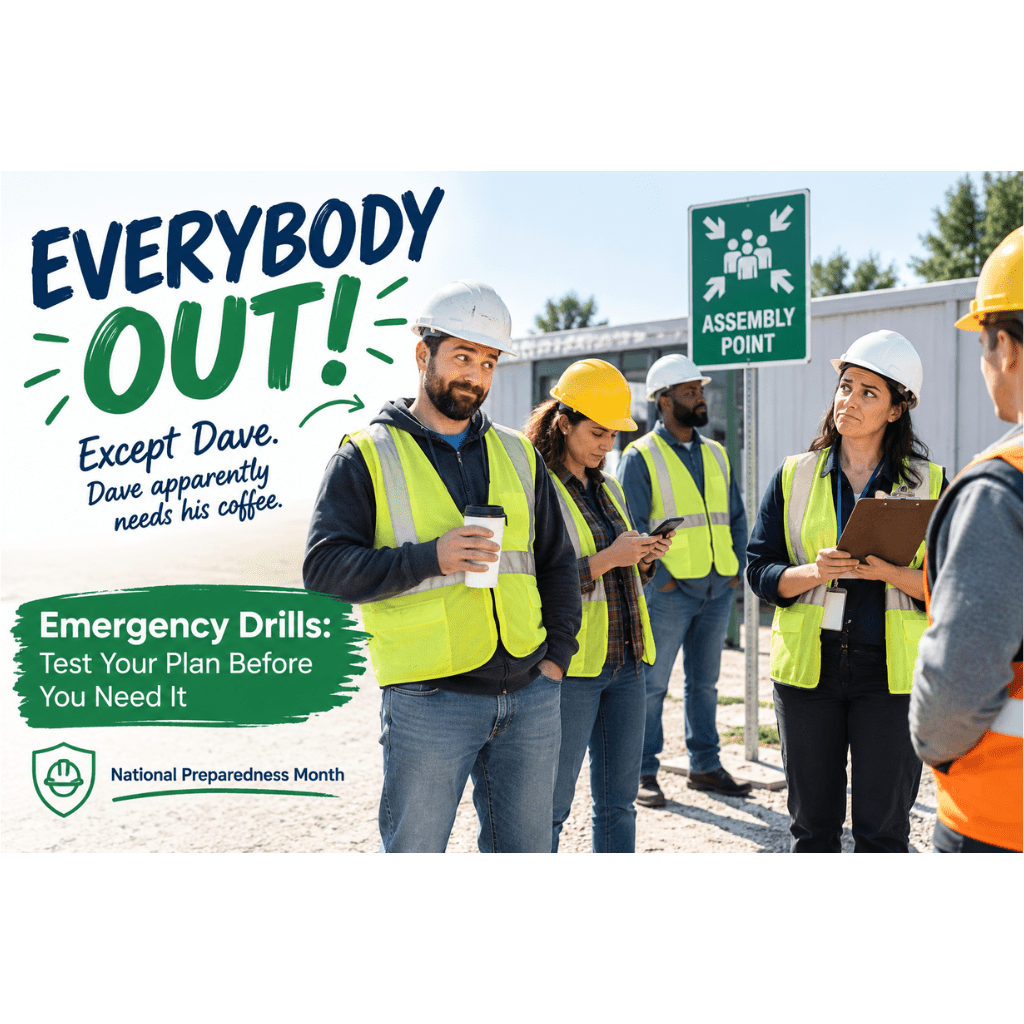
What About an Emergency Drill?
The same process applies even if the emergency wasn’t real.
After a drill, ask:
- What worked?
- What didn’t?
- Were employees confused?
- Did the alarm work?
- Did everyone know where to go?
- Was accountability accurate?
- Were emergency supplies accessible?
- Did supervisors understand their responsibilities?
- Did anyone identify a hazard we missed?
- What should change before the next drill?
OSHA specifically recommends gathering management and workers after drills to evaluate effectiveness, identify strengths and weaknesses, and determine ways to improve the plan.
A drill that ends with “Great job, everyone!” is nice.
A drill that ends with three specific improvements assigned to three specific people is much more useful.
After the Emergency Checklist
Before you consider the incident or drill completely closed, walk through this list:
- Everyone involved has been accounted for and appropriate follow-up completed
- The emergency was documented
- Employees involved were asked what they observed
- What worked was identified
- Problems and gaps were identified
- Used emergency supplies were replaced
- Expired supplies were removed
- Emergency equipment was inspected
- AEDs and other equipment were checked as applicable
- Communication procedures were reviewed
- Employee training needs were identified
- Emergency contacts were updated
- Evacuation or shelter locations were reviewed
- The Emergency Action Plan was updated if necessary
- Corrective actions were assigned
- Someone was responsible for following up
- Changes were tested through training or a future drill
The Goal Is Not a Perfect Emergency
No emergency response is going to look exactly like the plan on paper.
Real emergencies are messy.
People get nervous. Conditions change. Equipment doesn’t always cooperate. The person who normally handles something may not be there.
That’s why preparedness is a process.
Every emergency, near miss, or drill gives you information.
Use it.
Review what happened.
Replace what was used.
Fix what didn’t work.
Improve what you can.
Then train your people on the changes.
The Bottom Line
Emergency preparedness isn’t something you finish.
It’s something you maintain.
The emergency itself may last minutes or hours.
The lessons from it can make your workplace safer for years.
So once everyone is safe and the immediate crisis is over, don’t simply put the first aid kit back on the shelf and forget about it.
Review. Replace. Improve.
Then make sure your people know what changed.
Because the goal of emergency preparedness isn’t to have the perfect plan sitting in a binder.
The goal is to have a plan that works when your employees actually need it.
Need Help Getting Your Emergency Supplies Ready?
Southern Safety Supply carries first aid, emergency response, spill response, PPE, emergency lighting, eyewash, AED, and other safety supplies to help workplaces prepare for emergencies.
We can also help you identify the supplies that need to be replaced, replenished, or added after an emergency or drill.
And if keeping track of all those supplies is becoming its own emergency, that’s where NEVER OUT™ Inventory Management can help.
Our scheduled inventory service helps keep essential safety supplies checked, stocked, and ready so you aren’t discovering an empty shelf at the worst possible time.
Keep Building Your Emergency Preparedness Plan
This article is the final piece in our National Preparedness Month workplace safety series.
Continue exploring the series:
- National Preparedness Month: Your central resource for workplace emergency preparedness.
- 10 Workplace Emergency Preparedness Mistakes That Could Leave Your Team Unprepared.
- What Does OSHA Require for an Emergency Action Plan?
- Workplace Emergency Kits: What Should You Actually Have on Hand?
- First Aid and Emergency Supplies: What Does Your Workplace Really Need?
- Emergency Preparedness for Construction Sites: What Changes When the Jobsite Changes?
- Evacuation vs. Shelter-in-Place: Does Your Workplace Know the Difference?
- Emergency Drills: How to Test Your Plan Before You Need It.
- Severe Weather Emergency Preparedness: Is Your Workplace Ready?
- Spill Happens: Workplace Spill Response and Preparedness.
And don’t forget to download our Workplace Emergency Preparedness Checklist to help identify gaps in your current plan.
Important Note
This article is provided for general educational purposes and is not legal or safety consulting advice. Emergency drills should be planned for the specific hazards and conditions of your workplace. Do not conduct exercises that create unnecessary risk or interfere with actual emergency response. Follow applicable OSHA requirements and coordinate with appropriate safety personnel and emergency responders when necessary.