
When an emergency happens, one question can become very important very quickly:
Do we get out, or do we stay inside?
The answer depends on the emergency.
Sometimes the safest choice is to evacuate.
Other times, leaving the building can put employees in greater danger.
That is why a good Emergency Action Plan should address both evacuation and shelter-in-place when appropriate. OSHA specifically recommends that employers consider the conditions that would require evacuation and the conditions under which sheltering in place may be safer.
Knowing the difference can help employees respond faster and with less confusion.
What Does Evacuation Mean?
Evacuation means leaving a building, work area, or other location because remaining there presents a danger.
The goal is to move employees away from the hazard and toward a safe location.
Depending on the emergency, that might mean:
- Leaving the entire building
- Leaving only part of a building
- Moving to another area of the facility
- Moving to a designated assembly area
- Moving away from a specific hazard
OSHA’s Emergency Action Plan standard requires covered employers to establish emergency evacuation procedures, including the type of evacuation and exit route assignments.
When Might a Workplace Evacuate?
Evacuation may be appropriate when remaining inside creates a greater risk.
Examples can include:
- Fire
- Explosion
- Structural damage
- Certain hazardous-material releases
- Gas leaks
- Bomb threats
- Some workplace violence situations
- Other emergencies that make the building or work area unsafe
The correct response depends on the specific emergency.
For example, OSHA identifies fires, explosions, chemical releases, natural disasters, civil disturbances, and workplace violence among situations that may require evacuation planning.
What Does Shelter-in-Place Mean?
Shelter-in-place means staying inside a designated safe area instead of evacuating.
The idea is simple:
If the danger is outside the building or moving through the surrounding area, remaining inside may provide more protection than going outside.
OSHA describes shelter-in-place as selecting an interior room or rooms within a facility, often with few or no windows, and taking refuge there.
Depending on the emergency, sheltering may involve:
- Moving employees to designated interior areas
- Closing doors and windows
- Limiting outside air entry when appropriate
- Taking emergency supplies into the shelter area
- Accounting for employees
- Monitoring official instructions
- Remaining there until authorities or designated personnel provide further instructions
When Might Shelter-in-Place Make Sense?
Shelter-in-place may be appropriate when the hazard is outside the building and leaving would increase exposure.
Examples can include:
- A hazardous chemical release nearby
- A transportation accident involving hazardous materials
- Certain severe weather events
- A dangerous situation outside the facility
- Some workplace violence or active-threat situations
OSHA gives the example of a hazardous chemical release near a workplace where remaining indoors may be safer than evacuating through the contaminated area.
The key is to understand the hazard.
Staying inside isn’t automatically safer.
The emergency determines the response.
Evacuation vs. Shelter-in-Place
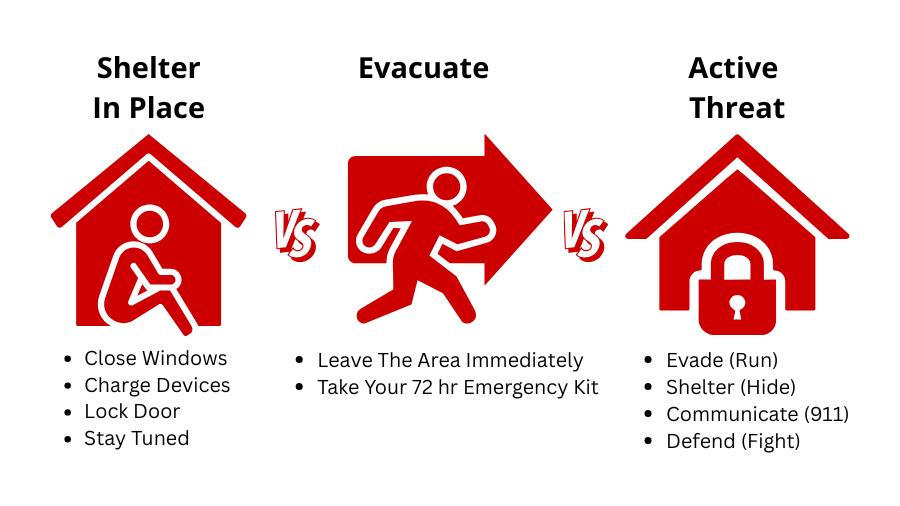
Here’s the simplest way to think about it:
| If the danger is… | The plan may call for… |
|---|---|
| Inside the building | Evacuation may be appropriate |
| Outside the building | Shelter-in-place may be appropriate |
| Moving toward or through the facility | Follow the specific emergency plan |
| A severe weather event | Shelter or evacuation may depend on the hazard |
| A hazardous-material release | Evacuation or sheltering may depend on the location and type of release |
| A fire or explosion | Evacuation is commonly part of the response |
| A dangerous intruder | Employees may need to evacuate or shelter depending on circumstances |
This isn’t a universal decision table.
The emergency, the workplace, and official instructions all matter.
Your Emergency Action Plan Should Address Both
A strong emergency plan shouldn’t simply say:
“In an emergency, evacuate.”
That’s not enough.
OSHA’s guidance says employers should identify the conditions that require evacuation and the conditions under which shelter-in-place may be better. See here.
Your plan should explain:
- What situations require evacuation
- What situations may require shelter-in-place
- Who can order an evacuation
- Who can initiate shelter-in-place procedures
- How employees will be notified
- Where employees should go
- How employees will be accounted for
- What happens to visitors and contractors
- How employees with special needs will be assisted
- How employees will receive further instructions
Don’t Use the Same Alarm for Everything
This is an easy detail to overlook.
If your workplace uses alarms or other signals for emergency actions, employees need to understand what those signals mean.
OSHA recommends that different emergency actions use distinguishable notification methods when appropriate. Its shelter-in-place guidance specifically recommends an alert that is distinguishable from the signal used for evacuation.
Think about it this way:
If the alarm goes off, employees shouldn’t have to ask, “What are we supposed to do?”
The signal should trigger a known response.
Where Would Employees Shelter?
“Stay inside” isn’t a complete shelter-in-place plan.
Employees need to know where to go.
A designated shelter area may be:
- An interior room
- An area with few or no windows
- A location away from the hazard
- An area appropriate for the type of emergency
The best location depends on the emergency.
For example, the ideal shelter location for severe weather may not be the same location used for a chemical release.
That is why emergency planning needs to consider different scenarios.
What Should Be Available in a Shelter Area?
The supplies you need will depend on your workplace and the emergencies you are planning for.
However, consider whether employees may need access to:
- Emergency communication
- Flashlights
- Batteries
- First aid supplies
- Drinking water
- Emergency contact information
- Employee rosters
- Basic emergency supplies
- Appropriate PPE
- Radios or other communication equipment (NOAA’s Weather Radar and Alerts App – iPhone Android)
For certain shelter-in-place situations, additional supplies may be appropriate.
The goal isn’t to turn a conference room into a survival bunker.
The goal is to make sure employees can safely remain there long enough to receive further instructions.
Account for Everyone
Whether employees evacuate or shelter in place, accountability matters.
Your emergency plan should explain how you will know who is safe.
That can include:
- Employee rosters
- Department lists
- Visitor logs
- Contractor lists
- Supervisors
- Designated accountability personnel
Construction sites may need additional planning because crews and subcontractors can change frequently.
For more information, see our guide to Emergency Preparedness for Construction Sites: What Changes When the Jobsite Changes?
Don’t Forget Visitors and Contractors
Your employees aren’t the only people who may need instructions.
Think about:
- Visitors
- Delivery drivers
- Contractors
- Temporary workers
- Customers
- Vendors
Someone who has never been inside your facility won’t automatically know where to go.
Your emergency procedures should include a way to account for people who aren’t part of your regular workforce.
Employees With Special Needs Need a Plan Too
Emergency planning should consider employees who may need additional assistance.
That could include people with:
- Mobility limitations
- Hearing limitations
- Vision limitations
- Language barriers
- Other circumstances that may affect their ability to receive or follow emergency instructions
OSHA specifically recommends considering special-needs employees as part of emergency planning.
The best time to figure this out is before the emergency.
What About Active Threats?
Active-threat situations are a good example of why “always evacuate” isn’t a sufficient emergency plan.
Depending on the circumstances, employees may need to evacuate, shelter, or take other actions based on the immediate threat.
OSHA includes special considerations for evacuation during an active shooter or other dangerous intruder situation in its emergency preparedness guidance.
Employees should receive clear training appropriate to the workplace rather than being expected to make up a response in the moment.
Construction Sites Have an Extra Challenge
Construction sites can make evacuation and shelter planning more complicated.
The safest location can change as the project changes.
Consider:
- Temporary structures
- Open floors
- Excavations
- Equipment
- Temporary power
- Changing access points
- Changing crews
- Severe weather exposure
- Limited enclosed areas
For construction companies, emergency plans should be reviewed as site conditions change.
OSHA’s construction standard, 29 CFR 1926.35, requires employers to establish the types of evacuation to be used in emergency circumstances and to train employees to assist with safe and orderly evacuation.
Practice Both Responses
You can have the best emergency plan in the world.
If nobody has practiced it, employees may still hesitate.
OSHA notes that drills and exercises can help workers understand and remember their roles and responsibilities during emergencies.
Consider practicing different scenarios.
For example:
Scenario 1: Fire in the facility
→ Evacuation
Scenario 2: Hazardous chemical release outside the building
→ Shelter-in-place
Scenario 3: Tornado warning
→ Move to designated shelter
Scenario 4: Emergency affecting one area of the building
→ Partial evacuation or relocation
After each exercise, ask:
What worked?
What didn’t?
What confused people?
Those answers can make your emergency plan better.
A Quick Evacuation vs. Shelter-in-Place Check
Walk through these questions with your team:
☐ Do employees know when they should evacuate?
☐ Do employees know when they may need to shelter in place?
☐ Are evacuation routes clearly identified?
☐ Are shelter locations clearly identified?
☐ Are emergency signals easy to understand?
☐ Can employees receive emergency instructions?
☐ Do you have a way to account for employees?
☐ Are visitors and contractors included?
☐ Have special-needs considerations been addressed?
☐ Are shelter supplies available where needed?
☐ Have employees practiced the procedures?
☐ Has the plan been reviewed since the workplace or jobsite changed?
If several answers are “I’m not sure,” that’s a good indication that your emergency plan deserves another look.
The Goal Is Knowing What to Do Before You Need It
Evacuation and shelter-in-place are not competing safety philosophies.
They are different tools for different emergencies.
The right response depends on the hazard, the workplace, and the information available at the time.
The important part is planning ahead.
Your employees should not have to figure out the plan while the emergency is happening.
They should already know:
Where do I go?
How do I get there?
What am I supposed to do when I get there?
Who tells me when it is safe?
That’s what preparedness looks like.
Take the Checklist to the Workplace
Want to put your emergency preparedness plan to the test?
Our Workplace Emergency Preparedness Checklist gives you a practical way to review evacuation, communication, accountability, emergency supplies, and other important areas.
Download the Workplace Emergency Preparedness Checklist and walk through it with your team.
Keep Building Your Emergency Preparedness Plan
This article is part of our National Preparedness Month work place safety series.
Continue exploring the series:
- National Preparedness Month: Your central resource for workplace emergency preparedness.
- 10 Workplace Emergency Preparedness Mistakes That Could Leave Your Team Unprepared.
- What Does OSHA Require for an Emergency Action Plan?
- Workplace Emergency Kits: What Should You Actually Have on Hand?
- First Aid and Emergency Supplies: What Does Your Workplace Really Need?
- Emergency Preparedness for Construction Sites: What Changes When the Jobsite Changes?
- Evacuation vs. Shelter-in-Place: Does Your Workplace Know the Difference?
- Emergency Drills: How to Test Your Plan Before You Need It.
- Severe Weather Emergency Preparedness: Is Your Workplace Ready?
- Spill Happens: Workplace Spill Response and Preparedness.
And don’t forget to download our Workplace Emergency Preparedness Checklist to help identify gaps in your current
Important Note
This article is provided for general educational purposes and is not legal or safety consulting advice. Emergency drills should be planned for the specific hazards and conditions of your workplace. Do not conduct exercises that create unnecessary risk or interfere with actual emergency response. Follow applicable OSHA requirements and coordinate with appropriate safety personnel and emergency responders when necessary.