
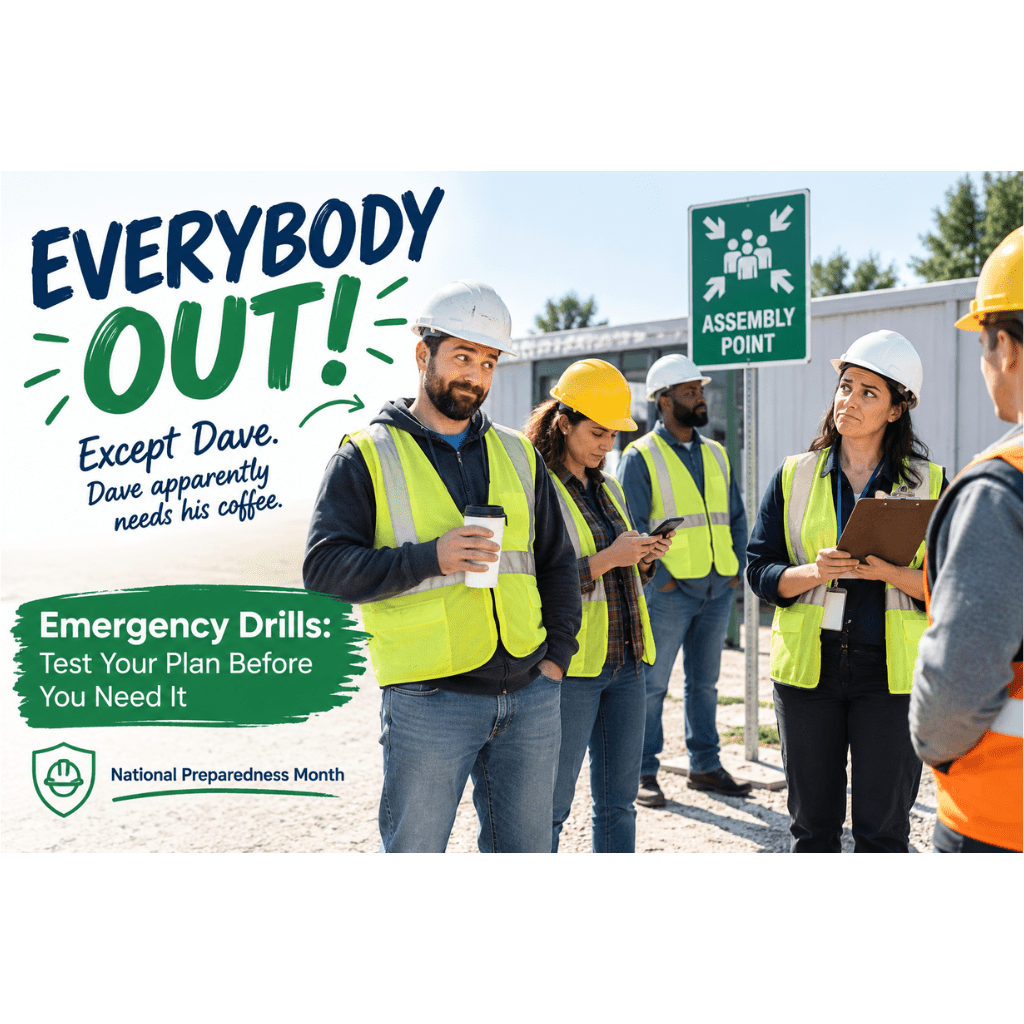
Nobody wants to hear the alarm go off at work.
Especially when someone says:
“Don’t worry. It’s just a drill.”
Cue the eye rolls.
Someone grabs their coffee.
Someone else asks if they really have to leave.
And there is always at least one person who suddenly discovers they have a very important meeting happening in the parking lot.
But here’s the thing:
Emergency drills matter.
A drill gives your team a chance to practice what to do before there is an actual emergency.
Because the middle of a fire, severe weather event, chemical spill, or other emergency is a terrible time to discover that nobody knows where the evacuation map is.
Why Do Emergency Drills Matter?
An emergency plan can look perfect on paper.
That doesn’t mean it will work perfectly in real life.
A drill can show you things that a written plan can’t.
Maybe the alarm can’t be heard in part of the building.
Maybe employees aren’t sure where to assemble.
Maybe the evacuation route is blocked.
Maybe nobody knows who is responsible for accounting for visitors.
Maybe the person responsible for the emergency plan is on vacation.
Oops.
That’s exactly why you test the plan.
OSHA recommends drills and exercises as a way to help workers understand and remember their roles and responsibilities during an emergency.
A Drill Is a Rehearsal, Not a Gotcha
The purpose of an emergency drill isn’t to catch employees doing something wrong.
It’s to find problems before the stakes are real.
Think of it like a fire drill for your emergency plan.
You’re looking for questions such as:
- Did everyone hear the alarm?
- Did people know where to go?
- Did anyone use the wrong exit?
- Was the assembly area large enough?
- Could supervisors account for their crews?
- Were visitors included?
- Did anyone get confused?
- Did emergency equipment get in the way?
- Did communication work?
If something doesn’t work during the drill, that’s good information.
Fix it.
That’s the whole point.
Start With the Emergency You Want to Test
You don’t have to simulate every possible disaster at once.
Pick one scenario.
For example:
Fire
Employees practice evacuation and accountability.
Severe weather
Employees practice moving to the designated shelter area.
Chemical spill
Employees practice reporting, isolating the area, and following the appropriate response procedures.
Workplace violence or active threat
Employees practice the procedures established for their facility and the specific situation.
Power outage
Employees practice communication, accountability, and safe shutdown procedures where applicable.
Different emergencies require different responses.
That’s why your drills should test different parts of your emergency plan over time.
Don’t Announce Every Drill
There’s a balance here.
Employees should know that drills are part of the safety program.
But if every drill is announced days in advance, you’re mostly testing whether people can remember something they were told to expect.
You may get a very orderly evacuation.
Congratulations.
You successfully evacuated a building because everyone knew Tuesday at 10:00 was evacuation day.
That’s not necessarily the same thing as testing your emergency plan.
OSHA’s emergency preparedness guidance encourages employers to conduct drills and exercises appropriate to their emergency plans and workplace hazards.
The exact approach should fit your workplace.
And don’t surprise employees with anything that could create a real safety risk.
Test the Alarm
Here’s an easy one.
Can everyone actually hear it?
Walk the facility.
Check:
- Offices
- Warehouses
- Restrooms
- Break rooms
- Outdoor work areas
- Mechanical rooms
- Noisy production areas
- Remote work areas
A beautiful alarm system doesn’t help the person who can’t hear it.
If your facility has multiple alarm signals, make sure employees understand what each one means.
Watch What Employees Actually Do
During a drill, resist the urge to jump in and correct everyone immediately.
Watch.
Where do people go?
Who stops to collect personal belongings?
Who heads for the nearest exit?
Who follows someone else because they aren’t sure what to do?
Who doesn’t move at all?
Who heads to the wrong assembly area?
This isn’t about embarrassing anybody.
It’s about learning where your plan needs work.
Check the Evacuation Routes
Walk the routes after the drill.
Ask:
Was anything in the way?
Construction materials.
Boxes.
Equipment.
Furniture.
Delivery carts.
That random pallet that has apparently been living there since 2024.
If employees can’t easily get through the route, it isn’t really an emergency exit route.
Construction sites need an additional level of attention because routes can change as the project progresses.
For more information, see our article on Emergency Preparedness for Construction Sites: What Changes When the Jobsite Changes?
Check the Assembly Area
Once everyone is outside, where do they go?
And can everyone fit?
The assembly area should be appropriate for your workplace and emergency plan.
During the drill, watch what happens.
Do people spread out?
Do employees know where their department or crew should assemble?
Can supervisors find their people?
Are employees standing somewhere that could interfere with emergency responders?
A meeting point is only useful if everyone knows where it is.
Practice Accountability
This is where the drill gets interesting.
Who is actually responsible for counting people?
Don’t assume someone will figure it out.
Your plan should identify who is responsible for employee accountability.
Depending on the workplace, that may involve:
- Supervisors
- Department managers
- Foremen
- Safety personnel
- Employee rosters
- Visitor logs
- Contractor lists
Construction sites have an additional challenge because the people on site can change throughout the day.
Your drill should test how you account for employees, subcontractors, visitors, and others who may be present.
Don’t Forget the People Who Aren’t There Every Day
A workplace isn’t always filled with the same people.
Think about:
- Visitors
- Contractors
- Delivery drivers
- Temporary workers
- New employees
- Customers
If your drill only works for your regular employees, your plan may have a hole in it.
Make sure your process includes people who may not know the building.
Test Communication
Emergency communication can get messy quickly.
During a drill, test:
- Alarm systems
- Radios
- Phones
- Public-address systems
- Text alerts
- Emergency contact lists
- Supervisor communication
Ask:
Did everyone receive the message?
And just as important:
Did everyone understand it?
“Something is happening” isn’t nearly as useful as:
“Evacuate the building using your assigned exit and report to the north parking lot assembly area.”
Try Something Besides a Fire Drill
Fire drills are important.
But they’re not the only emergency worth practicing.
If your emergency plan only gets tested when someone pulls the fire alarm, you’re leaving a lot of questions unanswered.
Consider rotating scenarios throughout the year.
Severe Weather Drill
Practice:
- Receiving the warning
- Moving to shelter
- Accounting for employees
- Communicating updates
Spill Response Exercise
Practice:
- Reporting the spill
- Identifying the material
- Isolating the area
- Locating the spill kit
- Identifying appropriate PPE
- Determining whether the spill is something employees can safely handle
Medical Emergency Exercise
Practice:
- Calling for help
- Directing emergency responders
- Retrieving first aid supplies or an AED
- Assigning someone to meet EMS
- Maintaining access to the injured worker
Evacuation Exercise
Practice:
- Alarm notification
- Exit routes
- Assembly
- Accountability
- Communication
The goal isn’t to create a Hollywood production.
The goal is to practice the response.
Construction Sites: Drill What Can Actually Change
Construction sites deserve special attention.
Your emergency plan may change because:
- The building is at a different stage
- The access road moved
- A new subcontractor arrived
- The crew changed
- The assembly area moved
- A stairway changed
- Temporary power was installed
- New hazards were introduced
That means a drill can do more than test employees.
It can test whether the current version of the plan still matches the current jobsite.
And that’s valuable.
Don’t Make the Drill Too Complicated
You don’t need smoke machines.
You don’t need crisis actors pretending to be injured.
You don’t need a dramatic countdown clock.
And please don’t create a scenario that puts employees or emergency responders at unnecessary risk.
A simple, well-planned exercise can reveal plenty.
Start with:
What are we testing?
Then decide:
What do we want to learn?
That’s enough.
After the Drill: Ask the Awkward Questions
This is the part people often skip.
Everyone goes back inside.
The coffee resumes.
Someone says, “Well, that went pretty well.”
And the drill disappears into history.
Don’t do that.
Spend a few minutes reviewing what happened.
Ask:
- What worked?
- What didn’t?
- What confused people?
- Was the alarm effective?
- Were the exits clear?
- Did everyone know where to go?
- Was accountability successful?
- Were visitors included?
- Did communication work?
- Did anyone identify a problem we hadn’t considered?
Most importantly:
What are we going to fix?
Write Down What You Learned
Keep a simple record of the exercise.
Document:
- Date
- Type of drill
- Scenario
- Participants
- What worked
- Problems identified
- Corrective actions
- Person responsible
- Target completion date
That turns a drill into an improvement tool.
Otherwise, six months later someone may say:
“Didn’t we have a problem with that last time?”
And nobody remembers.
Fix the Problems You Find
This is the most important part.
If the drill shows that the emergency exit is blocked, clear it.
If employees don’t understand the alarm, train them.
If the assembly area doesn’t work, change it.
If nobody knows who accounts for visitors, assign someone.
If the radio doesn’t work inside the warehouse, find another communication method.
Don’t let your drill become an annual tradition where everyone practices the same mistakes.
A Quick Emergency Drill Checklist
Before the next drill, ask:
☐ What emergency are we testing?
☐ What part of the emergency plan are we evaluating?
☐ Do employees know the basic emergency procedures?
☐ Are evacuation routes clear?
☐ Is the assembly area appropriate?
☐ Can employees hear or receive the emergency notification?
☐ Can supervisors account for their employees?
☐ Are visitors and contractors included?
☐ Are emergency contacts current?
☐ Are emergency supplies available?
☐ Did we identify corrective actions?
☐ Did someone take responsibility for fixing them?
☐ Will we follow up?
If the answer to that last question is “we’ll get around to it,” put a date on the calendar.
Future You will appreciate it.
The Best Drill Is the One That Teaches You Something
A perfect emergency drill isn’t necessarily the goal.
In fact, a drill that uncovers a problem can be incredibly valuable.
You found the problem without anyone being hurt.
That’s a win.
Emergency preparedness isn’t about predicting exactly what will happen.
It’s about giving your team the knowledge, training, equipment, and procedures they need to respond when something unexpected happens.
So run the drill.
Let it be a little awkward.
Find the problems.
Fix them.
Then do it again.
Because the emergency is not the time for a dress rehearsal.
Take the Checklist to the Workplace
Want to put your emergency preparedness plan through a practical check?
Our Workplace Emergency Preparedness Checklist can help you review evacuation procedures, communication, accountability, emergency supplies, and other important areas.
Download the Workplace Emergency Preparedness Checklist and use it during your next safety meeting, walkthrough, or emergency preparedness review.
Keep Building Your Emergency Preparedness Plan
This article is part of our National Preparedness Month workplace safety series.
For the big-picture guide, visit our National Preparedness Month: A Complete Guide to Workplace Emergency Preparedness.
You can also read:
10 Workplace Emergency Preparedness Mistakes That Could Leave Your Team Unprepared
What Does OSHA Require for an Emergency Action Plan?
Spill Happens: What Every Workplace Should Know About Spill Response
Emergency Preparedness for Construction Sites: What Changes When the Jobsite Changes?
Evacuation vs. Shelter-in-Place: Does Your Workplace Know the Difference?
Important Note
This article is provided for general educational purposes and is not legal or safety consulting advice. Emergency drills should be planned for the specific hazards and conditions of your workplace. Do not conduct exercises that create unnecessary risk or interfere with actual emergency response. Follow applicable OSHA requirements and coordinate with appropriate safety personnel and emergency responders when necessary.